When I attended Slippery Rock University, which as luck would have it is south of where I currently live, I had a professor who taught Philosophy named Robert A. Macoskey. He influenced me in a lot of ways; not the least of which was giving me a lifelong love of Philosophy, which I often credit as allowing me to succeed in nearly everything I’ve done in my life; because once you learn to think clearly and logically, you can do anything.
He was very interested in Sustainable Architecture and permaculture, or “Permanent Agriculture” which would influence me even today although not in the ways I expected. Permacutlture defined is “The development of agricultural ecosystems intended to be sustainable and self sufficient.” Or to put it another way, “live with nature” or “sustainability.”

Think of sustainability this way, you have a orchard full of fruit trees. Now around those fruit trees are various plants and grasses and weeds (defined by the way as any undesirable plant – so that rose growing in your fruit orchard is technically a weed). You could spend a lot of money on weed killers and mowers to keep the other plants in check. Not only are you spending money on chemicals and gasoline, but also in man hours, just to kill some weeds that are sucking up the nutrients in the soil that your trees need. Or you could do what nature would do.
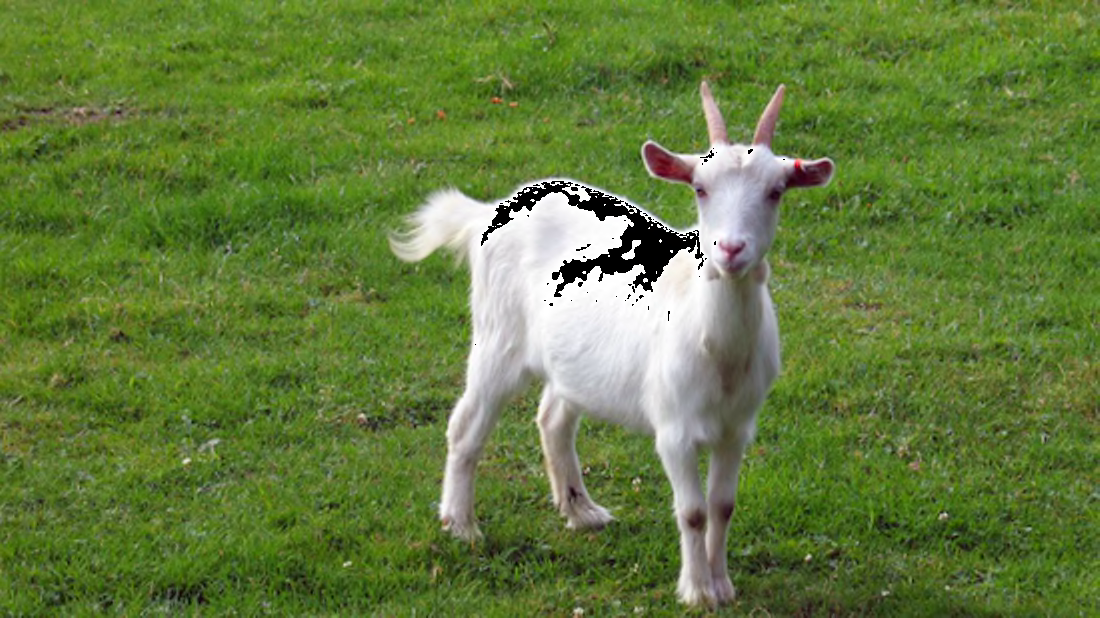
You send in the goats. These small herbivores eat the grass and shrubs that are crowding out trees. The goats also help the trees in another way…they poop. You are now fertilizing the trees.
Once the goats and other smaller herbivores have eaten the grass and shrubs the bigger herbivores move in, this would have been buffalo back in the day but today are more likely to be cows. They eat what the smaller herbivores miss. They also poop, helping to fertilize your trees.
Now with all that shit on the ground which is going to attract bugs. So instead of having to spend money on pesticides and man hours spraying the pesticide, you can send in the chickens. Chickens are omnivores meaning they eat grass and bugs and God knows what else. Again, they shit and helps fertilize the trees even more.
Now here is the benefit to you, the fruit tree farmer. Not only do you have money coming in from your lovely award winning fruits, but you also saved money BY not spending a shitload of cash on chemicals, fertilizers and man hours. You also created extra sources of revenue, for the goats and cows could be slaughtered for meat, milked or use that milk to make cheese. You have income from both the eggs, goat and chicken meat.[i]
Your system is pretty much closed and self sufficient. The “circle of life” continues. Now of course I’m oversimplifying it. However something like this system was used for hundreds, if not thousands, of years by countless farmers on all the continents. You live very close to the land and you begin to realize how everything is interconnected.
Somehow, somewhere we got away from that simple form of production. The reasons for it are complex…and are simply not sustainable, as the various environmental issues we face today clearly show.
Sustainable architecture is the idea
that you can either use various materials to reduce the environmental impact of
your building, or design it in such a way that it uses nature in some way to
generate power. For example, through
the use of solar panels, wind turbines or other methods, and again I’m
simplifying the issue. These were things that I intended to look into at a later date as well.
Being a lazy city boy I never really got into growing my veggies indoor; although Sue did grow an odd pepper or two and some tomatoes on our porch in Florida. The few gardens that we had growing up were not really that successful and there always seemed that there was something better to do with my time; like play on the computer. Pardon the pun, but the seed of permaculture and self sufficiency were planted by an old Philosophy professor and a British TV comedy that I used to watch on PBS called The Good Life or the alternative name Good Neighbors that was broadcast somewhere in the mid 80’s on the local PBS stations. The show dealt with the exact ideas we are talking about here, just in a comedic fashion. [ii]
For some reason…that seed was starting to germinate after being planted in my head a long time ago and had been dormant so for some time. Now that the pandemic hit the news was full of people getting chickens, or buying freezers or even growing their own food, that seed had taken root.
I am, in a small way, part of that trend. The two acres we had was largely wooded and although there were spaces for some gardens we wanted to try and keep it small. There was only the two of us and we no reason to plant twenty tomato plants for example.
No, I was not going fully into a homesteading mode. However the concept of being more self sufficient did appeal to me. It meant that I had to learn new tasks. It meant actually getting off my ass and doing something.
If you’re going to try and change your life, why not jump in with both feet?
[i] This example is taken (more or less) directly from “The Year of the Cow: How 420 pounds of Beef built a better life for one American family” by Jared Stone
Comments
Post a Comment